A Knovember to Remember….. Some discovered knowledge gems.

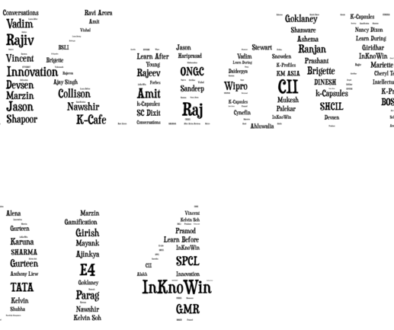
KM Asia 13 Speakers at KM Asia.
In this blog on KM Asia 2103 I share my takeaways from some of the other brilliant participants and their case studies. This is in no particular order.
Avi Kedem, CKO, Israel Aerospace Industries enlightened the conference with the very real issue of Knowledge Continuity of retirees’. However I can see that the same applies where vital knowledge is concentrated in a few.
There were two key take aways for me- 1) The 4 stage process that he has perfected and which he described in detail. 2) Identifying the Critical 5% Knowledge that represents 75% of the Vital Knowledge that needs to be transferred. If one gets the latter right, and follows the process, organizations will ensure Knowledge Continuity.
Cheryl Teh Su Meng, VP-KM, Khazanah Nasional Berhad, Malaysia caught my attention because of her unusual background. She was in KM with a consulting firm for many years before taking a break. When she returned to the field of KM she initially worked with Genting Highlands , an amusement park, before her current assignment at the Sovereign Fund of her country.
Cheryl brought forth a simple truth brilliantly- how does one describe what KM is and what is your role? According to her “IF YOUR MOTHER CAN EXPLAIN WHAT YOU DO, THEN YOU HAVE PERFECTLY DEFINED YOUR ROLE OF KM!” Thank you Cheryl for this insight. I am trying it with my mother (86 years) as well as with my wife of 22 years. I do not know if I will succeed. Will keep you updated.
Dr Ricky Tsui, Director R&D (eastern Region), ARUP, HK gave an outstanding presentation. What was unique that he delivered it in an almost ‘Pecha-Kucha’ style: 20 slides of 20 seconds each! Pecha-Kucha is a Japanese word for ‘chatter’ and is a technique devised by an architect couple in Tokyo. Dr Ricky was crisp, clear and well understood. He explained how KM has become the critical enabler for innovation and business success in Arup. I especially liked that fact that KM has achieved the ‘Holy Grail of KM’- ability to monetize the Intellectual Assets. They have been able to sell Products and Applications to a variety of clients such as wireless charging for Cars. They now sell their in-house developed Design Software ‘Oasys’ which evolved from the tools developed by their Communities of Practice.
Kelvn Soh, Social Intranet Manager, Singtel: Kelvin is unusually tall for a Singaporean. Behind the jovial demeanour is a creative genius. He is much awarded for designing innovative websites. His title tells it all. He is in charge for the innovative Singtel Social KM website- Espresso. And he enthralled the audience with his presentation starting with the launch date 11-11-11 and time 11-11. He explained that by keeping the familiar social media interface, acceptance was easier. However he warned that the focus should not be on technology – but on PEOPLE- the USERS! His 10 learnings/ rules began and ended with the need for ‘Executive Support’.
Dr Devsen Kruthiventhi, Head KM and L&D, TATA Projects presented the MAKE case study of TATA Chemicals which he was heading at that time. With a background in Mathematics and Academics (he was a maths professor) the late entrant to the KM world wowed the audience in his simple yet elegant style about how the KM program evolved over the years. Using the power of metaphors, the TITLI (Hindi for Butterfly) program cross pollinated knowledge from one part of the organization to the other. Dr Devsen shared how the humble ‘supervisor’ was identified as the Key holder of organization Knowledge and how they created programs to give this class of workers the importance they deserved. Everyone was interested in the sophisticated Key Performance Matrices that TATA Chemicals is now using to measure KM Efficiency, Effectiveness and Innovation.
So there were lots to be learnt at KM Asia. In the concluding part, I will cover some more speakers and their presentations and summarize my Top 5 Take aways from KM Asia 2013.